You do not have to be an experienced designer, marketer, or business owner to understand the importance of knowing your users or customers! The process of grasping this information is essential to all successful businesses. This activity isn't always the easiest as it requires you to think about your ideal customers before interacting with them (in most cases). So, where do you start? Let's break down how to create and understand your company's user personas step by step!
You do not have to be an experienced designer, marketer, or business owner to understand the importance of knowing your users or customers! The process of grasping this information is essential to all successful businesses. This activity isn't always the easiest as it requires you to think about your ideal customers before you have interacted with them (in most cases). So, where do you start? Let's break down how to create and understand your company's user-personas step-by-step!
What is a Customer Profile or User-Persona?
A user-persona is defined as; "a semi-fictional character based on your current (or ideal) customer. Personas can be created by talking to users and segmenting by various demographic and psychographic data to improve your product marketing." (Google)
Step 1 - Why Are You Creating A Persona?
Before we start any creative process or thinking about our users/ customers, we must make sure our campaign or project goals are aligned with what you want your users to get from your product or service. For example, if your product helps people sleep better, what might the customer's goal be? If you said "better sleep," this isn't quite the detail we're looking to achieve with this process. A better answer is; "the customer's goal is to be able to sleep soundly through the night without interruption." Other questions to keep in mind might be why the customer should use your product? Or what pain is my customer going through that my product or service can help?
Create 3-4 pain points your customer is currently dealing with that your product can solve.
Step 2 - Create High-Level Categories
Now we can start thinking about our customers; however, we want to create a boundary for our thinking. There are many ways to go about this, but I like to organize my "semi-fictional characters" by age. Age is just a number, but people within the same age range generally grew up inside the same time frame. Therefore, we can create generalized age ranges for our user-personas. I like to make three main categories; youngest, middle-aged, and oldest. I then pick an age range for these categories; this is to understand how to interrupt each persona. For example, the youngest type might be people that are between 21 and 29 years old.
You'll want to create broad categories of occupations, tech knowledge, and generalized demographics along with age.
Create 3-4 realistic age ranges, occupations, demographics, and tech knowledge for your characters. Do not take too much time to think about these items, as there is no right answer.
Step 3 - Customize Your Character!
This is where the fun part begins! In this step, you'll want to create the customer's first impressions. Not to be confused with their beliefs of your business, but the opposite. We're making the first impressions you'd think of if you were to see the customer in your store. These impressions are name, role/ occupation, profile photo, and a specific age with the category we created above.
Create 3-4 specific characters. Each character should be unique!
Step 4 - Character Personality
Next, we'll want to give our character a personality. We want to know their behaviors, pain points, and what their day-to-day might work. Using the information we collected in step one, we can align our "why" with each character's personality. Be creative here; there is no limit to what the person's personality can be as long as it aligns with our persona's goals. Below are a few questions that might aid you in your thinking process:
- Is the character open to trying new things, or do they need to sample it first?
- What does your character do if they are frustrated?
- What does the character value, and why?
Create personalities for each of your characters.
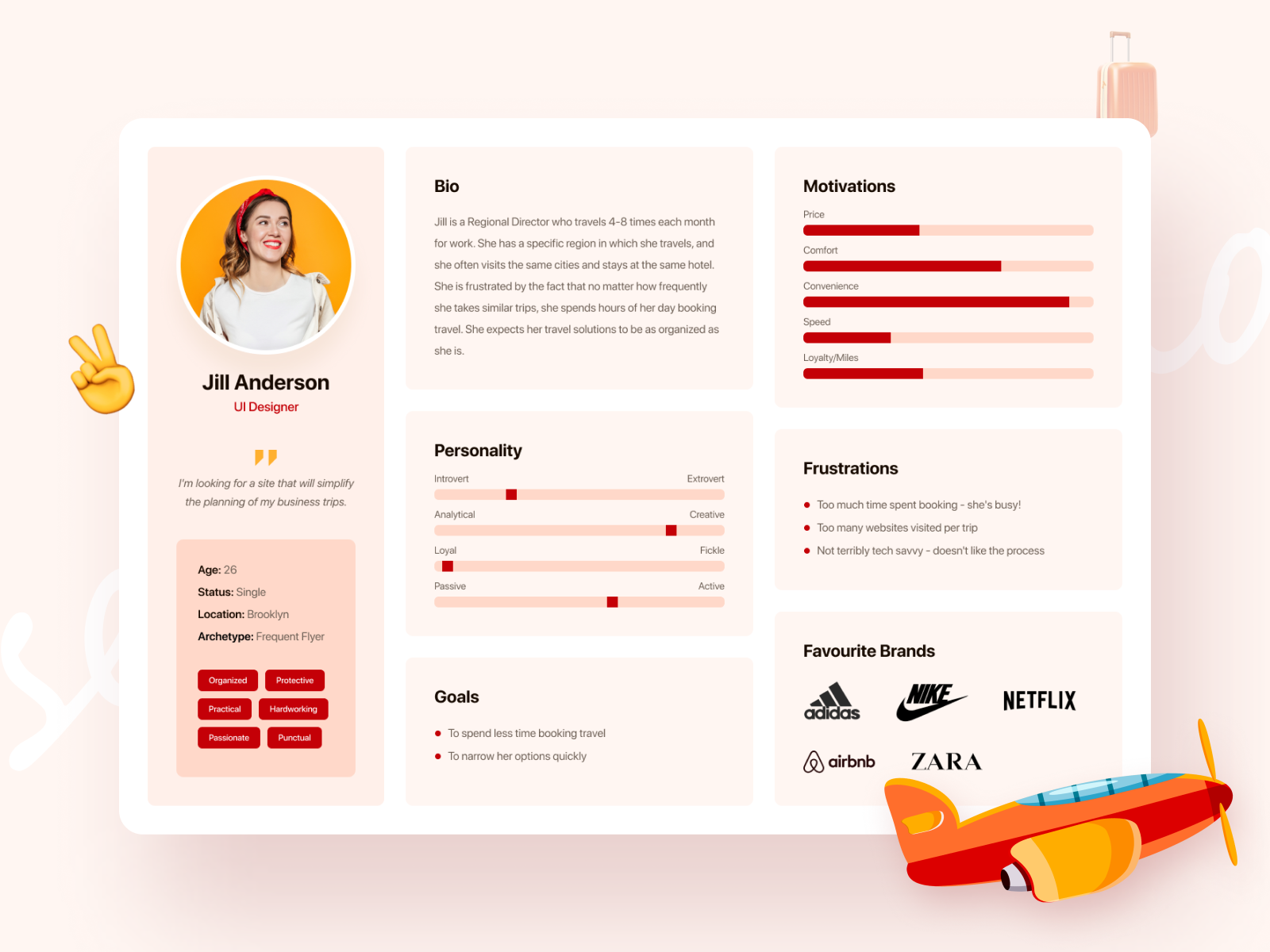
Example User-Persona Page From Previous Project
Step 5 - Re-define The Customer's Goals For Your Product Or Service
By now, you should have aligned your goals for the campaign with your character. However, now we want to tailor each destination to the character personally. This means we need to add a personal touch to each personality trait of our characters. Consider this step as the way to bring all of the fundamental pieces together. A good rule of thumb is to have your character's personalities, pain points, and goals in one place. Outlined below are simple questions you can answer to aid your creation of this step:
- What specific pain is your character going through? For example, the character's kids keep him up all night.
- What is essential to your character? Why?
- What are the character's values?
- How can your product connect with your character?
Step 6 - What Is Going To Stop Your Character From Buying?
In step six, we will break from specific character information and open our thoughts back up to become broader. Now, we want to think about what gets in the way of a user making a purchase. You'll want to be general here as these blocking factors will be applied to each character later on. Below are some examples of what could get in the way of your customer following through with a purchase or call to action:
- The user is worried your product will be too small to fit them.
- Shipping speed is too slow.
- Your checkout process has too many steps.
- The customer doesn't want to make an account.
- "Maybe I'll think about it and buy it later."
Once you've uncovered each factor that could stop your customer, you'll want to offer a solution to each item. For example, if a user is worried about shipping prices, a solution could be to provide free shipping or to include shipping in your pricing. Lastly, connect one or two blocking factors with a character. Person A will not follow through with a purchase if he/ she has to use a credit card for checkout rather than PayPal, for example.
Step 7 - Get Creative
Now that you have all the essential information on your goals, characters, pain points, etc., we want to put them all in one place! This document or sheet should be highly visual, exciting, and on-brand (if you already have an established brand).
The final product shouldn't look like a worksheet, template, or the examples above! Use the models below if you need inspiration for this step.
Once you've completed your user-personas' final design, double-check to make sure that you and your team are aligned with all the content presented. This is a crucial last step as you should now use the personas for every aspect of your brand, design, development, marketing, etc. These characters are not just for your marketing! Each element of your business should now be centered around your user-personas, as they can help guide you or your team towards specific decisions!
Thank you for viewing our user-persona tutorial. I hope you found this article helpful! If you did, consider subscribing to the blog below or following us on our social platforms. We have much more coming soon!
Inspiration for this article is from Ben Raph’s guide for creating personas. His Medium can be found here. Thumbnail image by Photo by Michael Dam on Unsplash.